Why Cache?
ActiveCampaign’s API rate limit is 5 requests per second. A CRM with 2,000 deals requires 20 paginated requests just to list them. If your analysis script runs multiple times a day, or you’re iterating on a report, those redundant API calls add up fast:
| Scenario | Without cache | With cache |
|---|---|---|
| First run (2,000 deals + custom fields) | ~40 API calls, ~12 sec | Same (cache is cold) |
| Second run 5 minutes later | ~40 API calls, ~12 sec | 0 API calls, <0.1 sec |
| Third run 15 minutes later | ~40 API calls, ~12 sec | ~4 API calls, ~2 sec (incremental) |
| Script crash mid-analysis, re-run | ~40 API calls, ~12 sec | 0 API calls, <0.1 sec |
The cache is especially valuable during development when you’re
re-running source("analysis.R") repeatedly.
How It Works
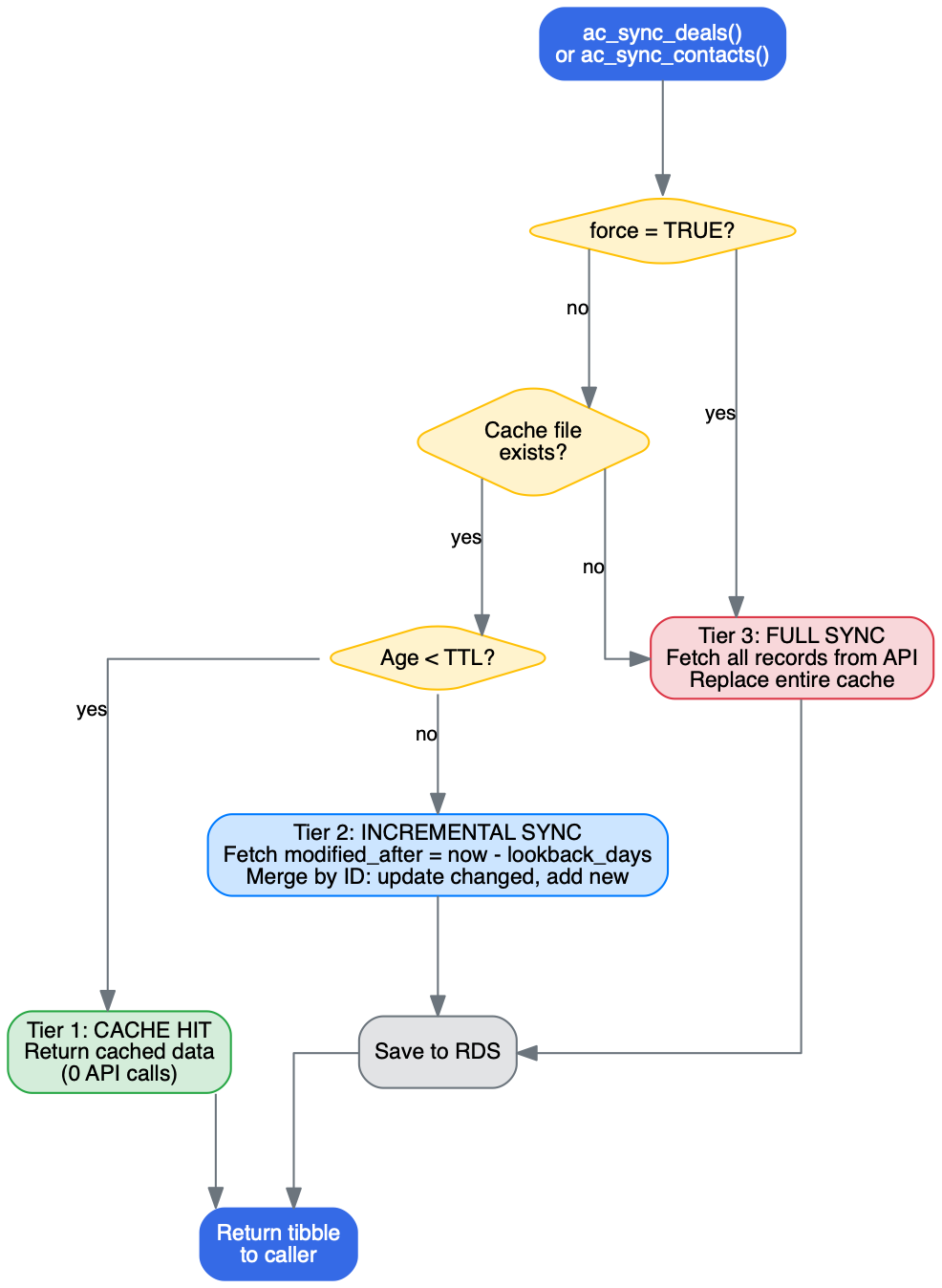
activecampaignr uses a three-tier strategy:
| Tier | Condition | Action | API calls |
|---|---|---|---|
| 1. Cache hit | Cache file exists and age < TTL | Return cached data | 0 |
| 2. Incremental sync | Cache exists but stale | Fetch records modified in last N days, merge by ID | Few |
| 3. Full sync | No cache file, or force = TRUE
|
Fetch everything from the API | All |
Basic Usage
library(activecampaignr)
ac_auth_from_env()

# The sync function handles the strategy automatically
result <- ac_sync_deals(
  lookback_days = 5,           # Tier 2: how far back to check
  ttl_minutes = 10,            # Tier 1: cache freshness threshold
  force = FALSE,               # Set TRUE to skip straight to Tier 3
  include_custom_fields = TRUE # Also cache custom fields
)

deals <- result$deals
custom_fields <- result$custom_fields
Merge Strategy
When performing incremental sync, the merge works by ID:
Stored:  [A v1, B v1, C v1]   (1,000 records from last full sync)
Fetched: [B v2, D v1]         (2 records changed in last 5 days)
Result: [A v1, B v2, C v1, D v1] (1,001 records)- Record B was updated: old version replaced with new
- Record D is new: appended
- Record A and C were unchanged: kept as-is
This means incremental sync fetches 2 records instead of 1,001, saving ~10 seconds and ~19 API calls.
Cache Storage
Cache files are standard R RDS files stored in a single directory.
# Default location
ac_cache_path()
# "~/.activecampaignr/cache"

# Change it (e.g., project-local cache)
ac_cache_path("~/my-project/.cache")

# Or set at auth time
ac_auth_from_env(cache_dir = "~/my-project/.cache")
Inspecting the Cache
ac_cache_status()
# # A tibble: 3 x 5
#   key                  rows age_minutes size_kb path
#   <chr>               <int>       <dbl>   <dbl> <chr>
# 1 contacts             2340       15.2    450.1 ~/.activecampaignr/cache/contacts.rds
# 2 deal_custom_fields    890        5.3    120.5 ~/.activecampaignr/cache/deal_custom_fields.rds
# 3 deals                 890        5.3    280.8 ~/.activecampaignr/cache/deals.rds
You can also read cache files directly if needed:
# Read a cache file manually
deals <- readRDS("~/.activecampaignr/cache/deals.rds")
Flushing the Cache
Clear everything
ac_cache_clear()
# i Removed 3 cached files
Clear a specific entity
ac_cache_clear("deals")           # Just deals
ac_cache_clear("deal_custom_fields")  # Just custom fields
ac_cache_clear("contacts")        # Just contacts
Force a fresh sync
Instead of clearing and re-fetching separately, use
force = TRUE:
# Equivalent to: clear + full sync in one step
result <- ac_sync_deals(force = TRUE)
Nuclear option: delete the cache directory
unlink(ac_cache_path(), recursive = TRUE)When to Flush
| Situation | Action |
|---|---|
| New custom fields added in AC | ac_cache_clear("deal_custom_fields") |
| Deals moved/deleted in bulk via AC UI | ac_sync_deals(force = TRUE) |
| Switching between AC accounts |
ac_cache_clear() then re-auth |
| Cache seems corrupt or stale | ac_cache_clear() |
| Routine analysis re-runs | Do nothing (cache handles it) |
Gotchas
Deleted records stay in cache
ActiveCampaign’s updated_after filter returns modified
records, but it does not tell you about deleted records. If a deal is
deleted in AC, incremental sync won’t remove it from your cached
data.
Fix: Run a full sync periodically (e.g., daily):
# Weekly full refresh in a scheduled script
ac_sync_deals(force = TRUE)
TTL is per-file, not per-session
The TTL is based on the cache file’s last-modified time on disk, not when you started your R session. If another script updates the cache file, your session will pick up that data on the next sync call.
Custom fields are not incrementally synced
ac_sync_deals(include_custom_fields = TRUE) re-fetches
all custom field values on every non-cache-hit call. The AC API does not
support updated_after filtering on custom field values, so
incremental sync is not possible for them.
For large accounts, custom field fetching is the slowest part. If you
only need deal metadata (no custom fields), set
include_custom_fields = FALSE:
result <- ac_sync_deals(include_custom_fields = FALSE)Cache is not shared across machines
The cache is local to the machine and user. If you run the same pipeline on CI or a different laptop, it starts with a cold cache. Consider committing a seed cache file to your project repo if cold start time matters.
Multiple AC accounts
The cache directory is shared by default. If you switch between AC accounts, flush the cache first:
# Switch accounts safely
ac_cache_clear()
ac_auth(url = "https://other-account.api-us1.com", api_key = "...")
Or use separate cache directories per account:
The ac_cache() Helper
For custom caching scenarios, use the low-level
ac_cache() function:
# Cache any expensive computation
pipelines <- ac_cache("pipelines", function() {
  ac_deal_pipelines()
}, ttl_minutes = 60)  # Pipelines rarely change

# Force refresh
pipelines <- ac_cache("pipelines", function() {
  ac_deal_pipelines()
}, force = TRUE)
Parallel Sync with future
For production pipelines, sync deals and contacts in parallel:
library(future)
plan(multisession, workers = 2)

library(progressr)
handlers(global = TRUE)

with_progress({
  p <- progressor(steps = 10)

  f_deals <- future({
    ac_sync_deals(.progress = p)
  }, seed = TRUE)

  f_contacts <- future({
    ac_sync_contacts(.progress = p)
  }, seed = TRUE)

  deals_result <- value(f_deals)
  contacts <- value(f_contacts)
})

plan(sequential)
Recommended Production Pattern
library(activecampaignr)
ac_auth_from_env(cache_dir = "data/cache")

# Daily scheduled script
result <- ac_sync_deals(
  lookback_days = 7,    # Generous lookback covers weekends
  ttl_minutes = 0,      # Always do at least incremental
  force = FALSE
)
contacts <- ac_sync_contacts(lookback_days = 7, ttl_minutes = 0)

# Weekly: force full refresh to catch deletions
if (weekdays(Sys.Date()) == "Monday") {
  result <- ac_sync_deals(force = TRUE)
  contacts <- ac_sync_contacts(force = TRUE)
}

# Analyse
deals <- ac_deals_full()